
Research to Impact: Beyond Knowledge Creation, How Can Universities Turn Research into Real Value for Society?

Published: 20 October 2026
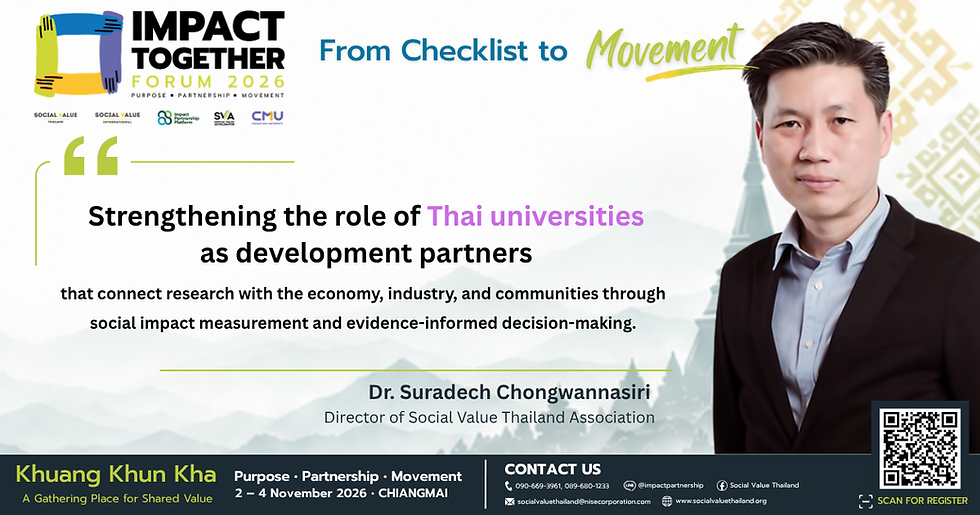
Author: Dr. Suradech Chongwannasiri Director of Social Value Thailand Association
When Universities Rise in the Rankings, Who Benefits?
If a university publishes more research papers, secures more patents, and climbs the global sustainability rankings, can we regard this as research success?
The THE Impact Rankings 2026 placed seven Thai universities among the world’s top 100, including Chiang Mai University at 49th and Mahidol University at 56th. These results reflect the progress of Thai higher education institutions in advancing the Sustainable Development Goals (SDGs).
Yet alongside these achievements, an important question remains for industry and communities: “Whose lives have these research projects changed, and how much value have they created for society?”
From Research Outputs to Impact: Success Does Not End with Publication
Research success has traditionally been assessed through the number of academic publications, patents, innovations, and research grants. These indicators reflect academic capacity, but they do not fully explain how knowledge creates change for people and society.
The Research to Impact approach invites us to consider research success at three levels: outputs, outcomes, and impact.
Outputs are the direct products of research, such as prototype technologies or new knowledge. Outcomes are the changes experienced by those who use the research, such as farmers reducing production costs or businesses improving operational efficiency. Impact considers these changes in light of external factors and what would have happened anyway, enabling a reasonable assessment of the contribution made by the research.
This distinction represents a shift from asking “What does the university produce?” to “What changes do those outputs create for society?”
Universities and the Co-Creation of Value for Change
Research impact cannot be created by researchers alone. It requires collaboration among universities, industry, government, and communities, from defining research questions to putting knowledge into practice.
Co-creation therefore plays an important role in transforming universities from one-way providers of knowledge into partners that design solutions together with those who will use them.
For example, agricultural research should not end with the development of a technology. It should also examine whether farmers can use it in practice, how much it reduces their costs, and how their quality of life changes.
Making the Value of Research Visible through Impact Assessment
Several Thai universities have begun using Social Return on Investment (SROI) to demonstrate the value of their research and academic services.
Mae Fah Luang University provides one example. It reported SROI assessments for six projects in the 2025 fiscal year, with project-level ratios ranging from 1.32:1 to 5.15:1. Its Arabica coffee project achieved an SROI ratio of 5.15:1.
However, SROI figures do not tell the whole story. The quality of an assessment depends on reliable data, listening to stakeholders, and considering impacts comprehensively to avoid claiming more value than was actually created.
From Impact Measurement to Research Policy Decisions
A case study from Chiang Mai University can illustrate how impact assessment and assurance help strengthen the credibility of research findings.
An even greater challenge, however, is using assessment findings to shape research questions and funding allocations in the next cycle. This also involves building collaboration across universities through the SVA network to improve assessment quality and support shared learning.
If Rankings Are Not the Goal, What Is the True Purpose of a University?
Global rankings may reflect a university’s progress, but they cannot fully explain the value its research creates for society.
The central task for higher education institutions is therefore to build systems that connect knowledge with practical use, track impact, and feed findings back into continuous improvement, alongside producing research.
These issues will be explored in Plenary #2: Research to Impact, featuring Chiang Mai University, King Mongkut’s University of Technology Thonburi, Muban Chombueng Rajabhat University, and Mahidol University, as well as through the Impact Showcase and Impact Lab #1.
Ultimately, a university’s value lies both in the knowledge it creates and in its ability to turn that knowledge into opportunities and a better quality of life for people.
From Knowledge to Collective Impact
We invite universities, researchers, research funders, and anyone interested in the topic to exchange approaches to assessing and managing research impact through the Research to Impact forum.
Together, we can help put knowledge into practice and create lasting social value.
Follow the event updates for further details and registration. SVA network members are eligible for a special registration rate.


Comments